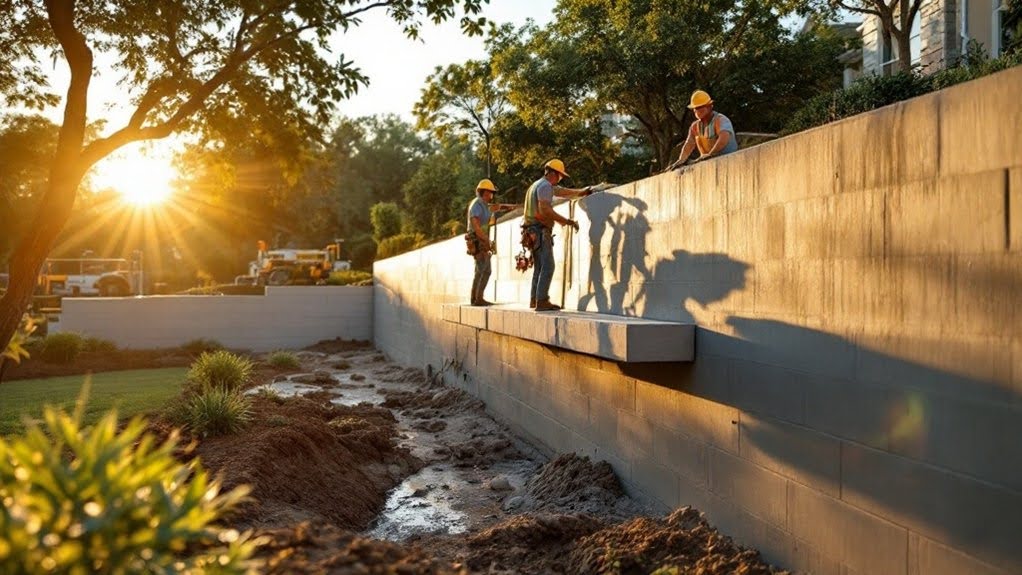
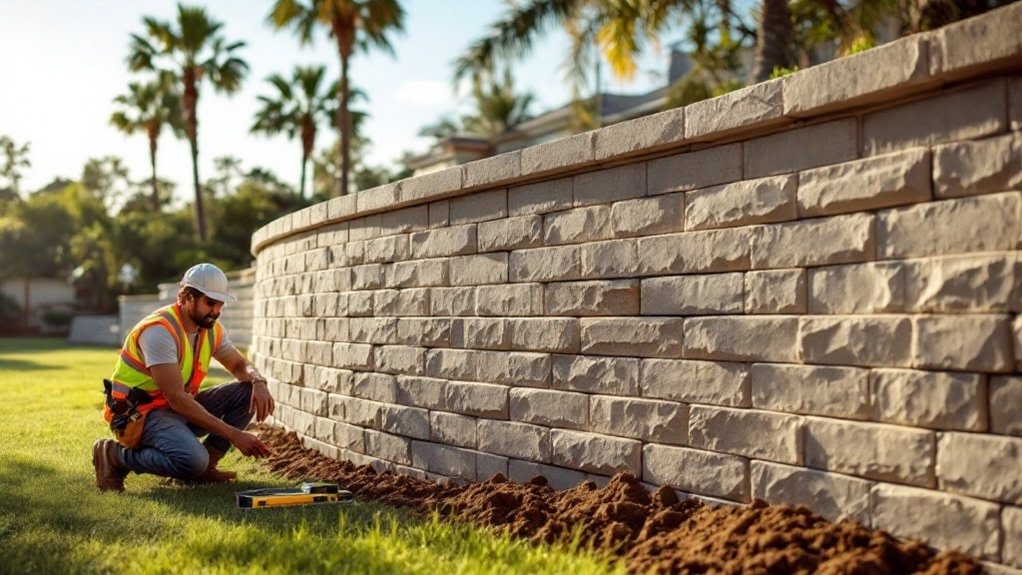
Recent Retaining Wall Projects in Jacksonville
4.6 out of 5 — 41 Google Reviews
“The quality of the workmanship really stands out: the concrete surface is smooth, level, and beautifully finished, with attention to detail around edges, drainage, and expansion joints. The stamped design and coloring look high-end and have already drawn compliments from neighbors, while still feeling durable enough to handle Florida weather.”
“Roy and the crew took care of everything needed for our driveway pour and replacement. The stamped pattern looks great and was one of the main reasons we hired them after seeing our neighbor's driveway and patio. Highly recommended.”
“Would definitely recommend this company to anyone with concrete needs. They are professional. Website is clear and direct for quotes!”
Do You Need One?
When a Retaining Wall is the Right Solution
A retaining wall does one job: it holds back a mass of soil that would otherwise slide or erode downhill due to gravity, water flow, or grade change. If you have any of the following conditions, a retaining wall is likely the correct long-term solution:
- Grade change of 12 inches or more between two areas of your property or between your property and an adjacent one. Unretained, soil at this elevation difference will erode over time, particularly during Jacksonville's heavy summer rain events.
- Active erosion. If you can see bare soil, washed-out channels, or your landscaping material migrating downhill after rain, erosion is already happening. A wall stops it permanently rather than requiring continuous maintenance.
- Landscaping terracing. Creating multiple level planting beds on a sloped lot requires retaining walls to hold each terrace in place.
- Building a level pad on a sloped lot. Shed foundations, pool decks, patios, and parking pads on slopes all require retaining the uphill side of the cut.
- Driveway cut into grade. A driveway that drops below grade to a garage or lower lot requires retaining walls along the cut sides.
- Pool excavation edge. The excavated walls around a pool install require temporary or permanent retention to prevent collapse during and after construction.
When you are uncertain whether your situation warrants a wall or another solution (grading, French drain, rip-rap), we can assess during our on-site quote visit and give you a clear recommendation.
Northeast Florida's Grade Challenges
Much of inland Jacksonville sits on relatively flat terrain. But the city's geography near the St. Johns River, its tributaries, and the Intracoastal creates frequent elevation changes on otherwise modest lots. Lots backing to marsh or creek often have significant rear grade drops.
These areas also see high seasonal rainfall (55 inches per year average) and occasional tropical storm events. Grade changes without proper retaining and drainage fail faster in this climate than in drier regions.
Our Site Visit Process
When we quote a retaining wall, we visit the site to measure the grade change, assess soil type, check for surcharge loads (structures, trees, or driveways above the wall), evaluate drainage direction, and verify setback clearances. You receive a written fixed-price quote.
No surprises in the field. Our quotes are detailed and fixed.
Construction Methods
Types of Retaining Walls We Build
Each wall type has distinct structural characteristics, cost profiles, and ideal applications. We recommend the type that fits your specific height, load, drainage, and budget requirements.
Poured Concrete Retaining Walls
Poured-in-place concrete walls are the strongest option for retaining walls. A continuous monolithic pour with reinforcing rebar creates a wall with no mortar joints, no block-to-block connections to fail, and very high resistance to lateral loading.
Poured walls require forming (temporary plywood or metal form panels held by snap ties), which adds labor cost but allows precise shape and thickness control. The result can be board-formed for a textured look, smooth-formed for a clean finish, or left as a utilitarian structural surface to be covered with stucco or cladding.
Best for: Walls over 6 feet requiring engineered specs; commercial applications; situations where maximum strength per linear foot is required.
CMU (Concrete Masonry Unit) Block Walls
Standard 8x8x16-inch CMU block is the most common retaining wall construction in Jacksonville. Blocks are laid in running-bond pattern on a concrete footing, with vertical rebar placed through the hollow block cores at specified spacing. The cores are then filled (grouted) solid with concrete to lock the rebar in place.
Properly built reinforced CMU walls are very strong and durable. They can be finished with stucco for a clean look, faced with stone veneer, or left as exposed block. Split-face CMU provides a decorative textured surface without additional cladding.
Best for: 2-8 foot walls with or without decoration; walls that need to match adjacent CMU construction; commercial and residential applications where versatility is needed.
Segmental Retaining Wall Block
Segmental retaining wall systems (Allan Block, Versa-Lok, and similar) are dry-stacked interlocking concrete blocks that rely on their mass, batter (backward lean), and interlocking geometry to resist lateral soil pressure. No mortar is used; the blocks interlock and are backfilled in lifts.
For walls under approximately 4 feet, segmental block is a cost-effective gravity wall solution and generally does not require engineering. For walls over 4 feet, geogrid reinforcing fabric is required at specified intervals within the backfill, and engineering drawings are typically needed for permit.
Best for: Landscape terracing walls under 4 feet; areas needing decorative textured look; situations where budget is primary constraint and structural loads are modest.
The Most Common Cause of Retaining Wall Failure
Hydrostatic pressure. When rainwater saturates the soil behind a wall and has no path to drain, the weight and pressure of that saturated soil mass can easily overpower a wall that would otherwise handle dry soil loads with ease.
In Jacksonville's climate, with summer thunderstorms delivering 2-4 inches of rain in a single afternoon, this is not a rare scenario. It happens several times per year on most properties.
Walls without proper drainage show predictable symptoms: bulging, cracking at the base, block tipping forward, and eventually collapse. We see this regularly on walls that were built without drainage. It is preventable with proper design.
We Get Drainage Right
Florida Soil and Drainage in Every Wall We Build
Our retaining wall drainage system is included in every project, not sold as an add-on. It consists of:
- Clean drainage aggregate (57-stone) placed directly behind the wall for a minimum of 12 inches of width. This zone is free-draining and does not hold water like native soil.
- Filter fabric (geotextile) wrapped around the drainage stone to prevent native soil from migrating into the aggregate over time and clogging it. Without this, even well-installed drainage stone eventually fails as fine soil particles wash into it.
- Weep holes or gaps in the wall face at base level every 4 to 6 feet, allowing water that has collected in the drainage aggregate to exit through the wall face. Weep holes are critical for CMU and poured walls.
- Perforated drain pipe at the footing for walls over 4 feet tall or in high-rainfall exposure positions. The pipe collects water from the entire drainage zone and carries it to a daylight outlet or inlet structure.
Our drainage specifications are detailed in every project quote so you know exactly what is being installed and why.
Know Before You Build
Duval County Permit Requirements for Retaining Walls
Retaining walls in Duval County fall under the Florida Building Code and Duval County Building Inspection Division jurisdiction. General rules:
Under 48 Inches
Walls under 48 inches in retained height typically do not require a permit. However, setback rules, drainage easements, and HOA covenants still apply. Check before building.
Over 48 Inches
Walls over 48 inches in retained height require a permit and engineering drawings stamped by a licensed structural engineer. We coordinate with our engineering partners to produce the required drawings as part of our project scope.
Commercial Properties
Retaining walls on commercial properties require permits regardless of height. Commercial walls are subject to additional wind load, drainage, and site plan review requirements.
We handle all permit applications through Duval County Building Inspection Division. Work is inspected and the permit is closed in county records. This protects you at resale and provides documentation that the wall was built to code.
Why unpermitted retaining walls are a problem at sale: A real estate inspector and a buyer's attorney will find an unpermitted wall. You will be asked to either pull a retroactive permit (which requires exposing the wall's construction to inspect compliance) or tear it down. Build it right once.
Setback Rules
Retaining walls are subject to the same setback requirements as structures. In most Duval County residential zones, you cannot build a wall directly on the property line. Setback distances vary by zone and wall height.
Corner lots have additional restrictions related to the visibility triangle at road intersections. We verify setback compliance before finalizing any quote near a property line.
Drainage Easements
Many Duval County residential lots have drainage easements (typically 5-10 feet) along rear or side property lines. A retaining wall that blocks or alters drainage flow within an easement can create liability and code violations.
We check for recorded easements on your property before designing any wall near the lot boundary.
Our License
FL CBC1269043 is our General Contractor license, allowing us to pull structural permits in Duval County including retaining walls requiring engineering review. We carry general liability and workers compensation insurance.
What to Expect
Height, Type, and Pricing Guidance
Retaining wall cost varies significantly by height, material type, drainage requirements, site access, and whether engineering is needed. The following provides ballpark ranges; we provide fixed written quotes after site visit.
Prices above are starting ranges for Jacksonville-area projects. Site access difficulty, drainage requirements, and surface finish choices affect final pricing. Split-face block adds $5-10/LF over standard CMU. All quotes are fixed price with no change orders for items within original scope.
Common Questions
Retaining Wall FAQ
Do I need a permit for a retaining wall in Jacksonville? +
Under Duval County's current Building Code, retaining walls over 48 inches (4 feet) in retained height require a permit from Duval County Building Inspection Division. Walls on commercial property require permits regardless of height. We verify current permit thresholds with the county before any project, as local requirements can be updated. We pull all required permits under our General Contractor license FL CBC1269043 and manage the inspection process. Homeowners who build retaining walls without required permits often discover this creates problems during home sale inspections -- the costs of retroactive compliance or demolition typically far exceed the original permit cost.
What causes retaining walls to fail? +
The four most common failure causes we see in Jacksonville are: (1) Inadequate drainage -- hydrostatic pressure from saturated soil behind the wall pushes it forward. This is the number one cause of residential retaining wall failures in Florida's high-rainfall climate. (2) Inadequate footing -- walls built without a proper reinforced concrete footing below grade can rotate forward at the base. (3) CMU walls without rebar and grouted cores -- hollow-core block walls with no reinforcement fail quickly when loaded laterally. (4) Surcharge loads -- a structure, driveway, or loaded vehicle parked directly above a wall that was not designed for that load. Any properly designed wall accounts for the anticipated load above it.
How long does a concrete retaining wall last? +
Properly built poured concrete or reinforced CMU walls with adequate drainage last 50+ years. Concrete does not rot, rust (the rebar inside does if moisture penetrates, but properly placed concrete cover prevents this), or decompose in Florida's climate. Segmental block walls with proper base preparation and drainage typically last 20-30 years before mortar-free joints begin to shift. The longevity of any wall is primarily determined by the quality of drainage behind it and the adequacy of the footing beneath it -- not the surface material.
Can a retaining wall be built against my property line? +
Generally not directly on the property line. Duval County zoning regulations include setback requirements that apply to retaining walls, though the specific setback distance depends on your zoning district, wall height, and whether it is a side yard, rear yard, or front yard location. There are also restrictions related to drainage easements that are often recorded along rear and side property lines. If you are trying to retain a grade change right at a property line, we will review the specific setbacks for your parcel during our site visit and quote the wall accordingly. In some cases, a tiered wall design can achieve the same grade change while keeping each tier within setback limits.
Get a Quote
Request Your Retaining Wall Quote
Tell us about your project -- grade change height, approximate linear footage, and your zip code. We will schedule a site visit and deliver a written fixed-price quote.
FL CBC1269043 • Licensed • Insured • Written fixed-price quote
Serving Jacksonville Since 2013
Retaining Walls Built Right the First Time
Seamless Concrete Contractors builds properly drained, fully permitted concrete and CMU retaining walls throughout Duval County. Fixed-price quotes, no surprises.
FL CBC1269043 • Licensed • Insured • Written fixed-price quote
Why the Right Concrete Contractor Matters in Jacksonville
The cheapest quote is rarely the cheapest job. Here is how a licensed, in-house crew compares to the day-crews and unlicensed pours common across Duval County.
The Seamless Standard
Every driveway, patio, and slab we pour is built on a properly compacted sub-base, jointed to control cracking, and mixed to Florida Building Code. If our workmanship fails structurally, we come back and make it right, in writing, on every project.
Serving All of Jacksonville and Duval County
From the Beaches to the Westside, Northside to Mandarin. Plus Nassau, St. Johns, and Clay counties.