Decorative Concrete in Jacksonville, FL
Decorative concrete covers eight or more distinct finishes, each suited to a different surface, budget, and visual outcome. This page explains them all so you can make an informed choice. FL Certified Building Contractor CBC1269043.
Recent Decorative Concrete Projects in Jacksonville
4.6 out of 5 — 41 Google Reviews
“The quality of the workmanship really stands out: the concrete surface is smooth, level, and beautifully finished, with attention to detail around edges, drainage, and expansion joints. The stamped design and coloring look high-end and have already drawn compliments from neighbors, while still feeling durable enough to handle Florida weather.”
“Roy and the crew took care of everything needed for our driveway pour and replacement. The stamped pattern looks great and was one of the main reasons we hired them after seeing our neighbor's driveway and patio. Highly recommended.”
“Would definitely recommend this company to anyone with concrete needs. They are professional. Website is clear and direct for quotes!”
Decorative concrete is not one thing
When a homeowner says they want "decorative concrete," they could mean a stamped driveway, a polished epoxy garage floor, an acid-stained interior slab, or a spray-texture pool deck. Each of these is a fundamentally different process, different material, and different price range. Choosing the wrong one for a given application is a common and expensive mistake.
The most important distinction is whether color and texture are being applied to new concrete poured as part of the project, or to existing concrete that is already in place. That single factor eliminates several options immediately:
- Integral color (pigment in the mix)
- Color hardener (dry-shake, surface)
- Stamped patterns
- Exposed aggregate
- Salt finish
- Broom or trowel finish
- Acid stain
- Acetone dye
- Epoxy overlay
- Micro-topping
- Polished concrete
- Spray knockdown overlay
The second major distinction is indoor vs outdoor use. Florida's exterior climate is harsh on finishes that perform well in controlled environments. Acid stain and polished concrete that look exceptional on an interior slab require different specifications outdoors, and some finishes should not be used outdoors at all. We walk through each option below with honest notes on where it works and where it does not.
Every decorative concrete option, explained
Descriptions, best-use cases, and typical installed price ranges for the Jacksonville market.
Stamped Concrete
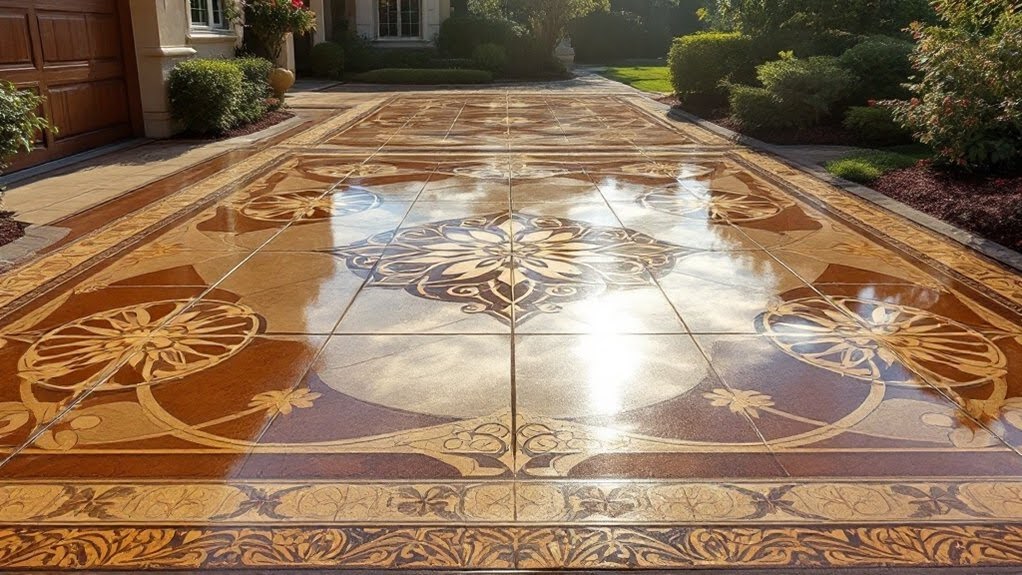
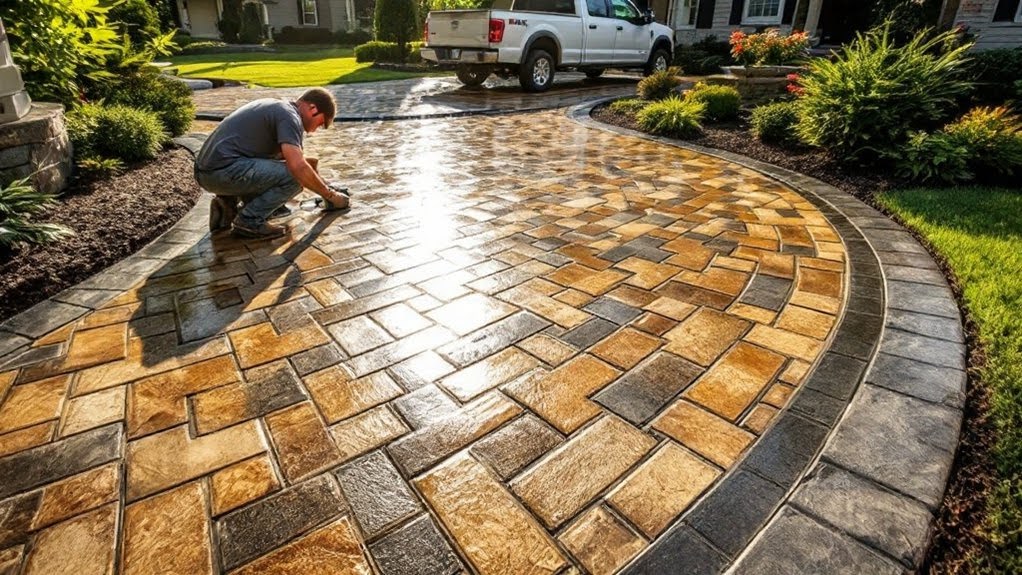
Stone, slate, brick, cobblestone, or wood-plank patterns pressed into fresh concrete with color hardener and antiquing release agent applied to create a two-tone finish. Requires a new pour. The dominant decorative option for Jacksonville driveways, patios, and pool decks where a premium look is the goal.
Acid Stain
A dilute acid solution containing metallic salts reacts chemically with the lime content in the concrete. The reaction creates a translucent, mottled, marbled color effect that is completely unique to each slab. Unlike paint or dye, acid stain is a permanent chemical reaction with the concrete itself. Colors are limited to earthy tones: browns, tans, terracotta, olive, and blue-green ranges. Works on old concrete that is clean and unsealed.
Acetone Dye
Acetone-based dyes physically absorb into the concrete pores rather than reacting chemically. The key difference from acid stain: the color range is far wider (nearly any color is available), the color is more vivid and uniform, and the result is more predictable. Best used on interior polished floors where UV degradation is not a concern. Not recommended for exterior Jacksonville use because UV breaks down the dye rapidly. Excellent for high-end interior residential or commercial polished concrete floors.
Polished Concrete
A multi-step wet-grinding and honing process using progressively finer diamond-tooled floor machines. Typically starts at 40 or 80 grit and proceeds through 400, 800, and up to 3,000 grit for a high-gloss finish. Hardener is applied between passes to densify the concrete and prevent dusting. Price varies by how many grinding stages are required and what finish level (satin vs high-gloss) is specified. Popular for commercial lobbies, retail floors, high-end residential, and garage floors where a durable, cleanable, non-coating surface is preferred.
Epoxy Overlay
A two-part epoxy coating bonded to the prepared existing concrete surface. Available in solid colors or with decorative chip/flake systems broadcast into the wet epoxy. Extremely durable and chemical-resistant. The critical installation requirement: the existing concrete must be completely dry and free of moisture vapor transmission. Florida's high water table and slab-on-grade construction means moisture testing before an epoxy application is not optional. Moisture in the slab will cause epoxy to delaminate.
Micro-Topping
A cement-based overlay applied in very thin coats (typically 1/16 to 1/8 inch) over existing concrete, wood, or tile. The result is a seamless, smooth surface with no grout lines. Popular for contemporary residential interiors, countertops, and bathroom floors. The ultra-thin layer is not structural and does not add strength to the substrate. Requires a very stable, crack-free base because any movement in the substrate will telegraph through. Not appropriate over cracked or settling concrete without prior repair.
Spray Knockdown
Also called spray texture or splatter texture, knockdown is a thin cement-based overlay sprayed onto existing concrete and then partially knocked down with a trowel while still wet. The result is a varied, mottled surface texture that is non-slip, durable, and economical. The dominant choice for Florida pool decks and outdoor patio resurfacing. Can be applied over existing concrete in reasonable condition. Color options are available but limited compared to other decorative systems.
Salt Finish
Rock salt is pressed into fresh concrete while it is still workable, then washed out as it cures. The dissolved salt crystals leave small, random pits across the surface that create a natural slip-resistant texture. Requires a new pour. One of the most economical decorative options because it adds minimal labor to a standard pour. A common specification for Florida pool decks, driveways adjacent to pool areas, and exterior walkways where texture is needed without the cost of stamping.
How to choose the right finish
Start with these questions and the options narrow quickly.
Decorative concrete questions
How is decorative concrete different from painted concrete?
Does acid stain work on old concrete?
Can you stain concrete that has already been sealed?
Is decorative concrete slippery?
Explore specific decorative options
Get a Decorative Concrete Quote
Tell us which finish you are considering, the surface area, and whether it is new concrete or an existing slab. We will respond with a written, fixed-price quote.
Why the Right Concrete Contractor Matters in Jacksonville
The cheapest quote is rarely the cheapest job. Here is how a licensed, in-house crew compares to the day-crews and unlicensed pours common across Duval County.
The Seamless Standard
Every driveway, patio, and slab we pour is built on a properly compacted sub-base, jointed to control cracking, and mixed to Florida Building Code. If our workmanship fails structurally, we come back and make it right, in writing, on every project.
Serving All of Jacksonville and Duval County
From the Beaches to the Westside, Northside to Mandarin. Plus Nassau, St. Johns, and Clay counties.
Not sure which finish is right for your project?
Call us and describe what you are working with. We can tell you which options are realistic for your surface, budget, and Jacksonville climate in about five minutes. FL CBC1269043.